ARTICLES

Post-Blended Compounds Ensure Uniformity

FARMINGTON, CT — Polymer Resources Ltd., a leading U.S. plastics compounder, continues to advance the manufacturing of high-quality, customized specialty engineering resins. Serving a global network of molders and extruders, the company provides tailored thermoplastic solutions for critical applications in the medical device, electronics, automotive, construction, and consumer goods sectors.

The company's extensive portfolio features a wide range of performance grades, including polycarbonate (PC), ABS, PC/ABS, PPO, PBT, ASA, polyetherimide (PEI), and nylon-based chemistries and blends. Polymer Resources leverages a strategic dual-facility footprint to meet specific client requirements: its Farmington headquarters specializes in highly specified custom-color resins, while its Rochester, N.Y., facility also focuses on highly specified dark colored resins, recycled grades, and advanced Research & Development (R&D).


Obstacles to maintaining colorant and additive consistency

The Farmington site operates both single and twin-screw compounding lines. To ensure that all compounds from a single production run are identical in color, melt properties, and mechanical performance, they are often blended following extrusion and pelletizing.

"We're very quality-focused, and the color and other properties need to be spot on," says Cole Accardi, lead process engineer," adding, "If we have an 80,000 lb (36,287 kg) run, the color could drift slightly from the beginning to the end of the run." Post-blending ensures absolute consistency of color and properties throughout the order.

A ribbon blender previously handled the post-blending but began to threaten product quality. "We were experiencing contamination issues because operators could not clean the blender thoroughly," explains Accardi. "It had nooks and crannies where pellets could lodge." Cleaning required several hours, and still the risk of contamination remained, sparking quality concerns. "That's when we began researching alternatives."

While ribbon blenders perform successfully elsewhere in the plant, Accardi sought a mixer for post-blending that minimized or eliminated heat and shear. "If we introduce heat and shear, we can generate dust and effect color changes, especially with lighter colors," he explains. "If we mix a white compound in a ribbon blender a bit too long, it may begin to yellow."

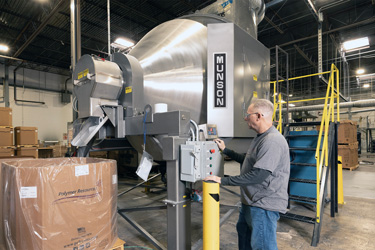
Accardi and his colleagues ultimately replaced the ribbon blender with a 140 cu ft (4 m3) capacity Rotary Batch Mixer, model 700-TS-140, from Munson Machinery. It has no agitators and thus no internal shafts or bearings. Instead, its horizontal vessel rotates on external trunnion rings located at each end. "We purchased this blender because it has the most gentle mixing that we could get, and it won't alter the properties of our material because there's no heat generation."


Improved post blending ensures color and additive uniformity

Pelletized compounds are discharged into Gaylord containers, each having a capacity of roughly 1,500 lb (680 kg). At the conclusion of a production run, the contents of each container undergo testing to assess uniformity of all properties including color, melt flow, impact resistance, and flame. If any variation is detected, the containers are forklifted to the post-blending area.

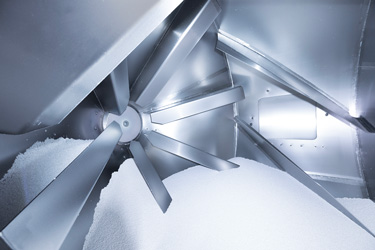
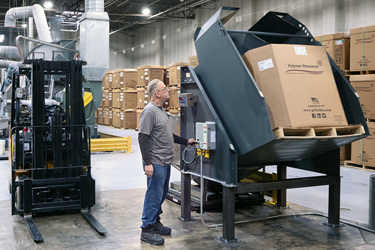
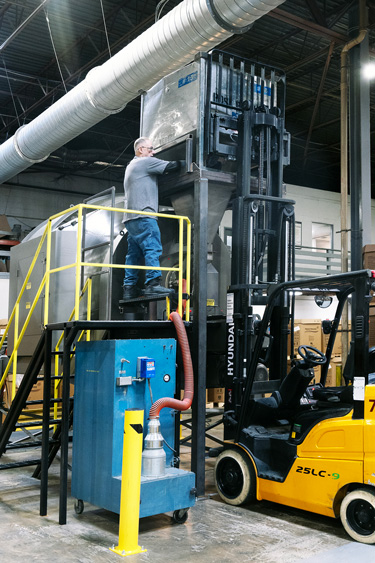
Here, a box dumper unloads the entire contents of each container into a portable stainless steel hopper of equivalent capacity. A forklift operator then raises the hopper to a stand above the mixer's stationary inlet. While the mixer rotates, the operator opens the hopper's knife gate, allowing full discharge into the mixing vessel, where mixing flights create a gentle four-way tumble-turn-cut-fold mixing action, achieving total batch uniformity in two to three minutes.

The mixer handles up to 6,000 lb (2722 kg) per batch, equivalent to four Gaylords.

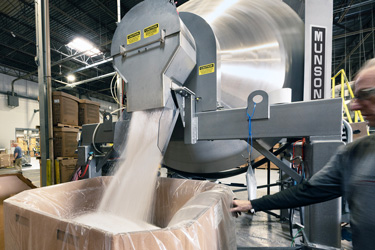
As the vessel continues to rotate, material is discharged through a pneumatically actuated plug gate valve into a box resting on a scale below. The steady flow of material enables operators to achieve accurate fill weights, says Accardi. Once all compounds from a production run are blended and quality tested, the boxes are sealed for shipment.


Partial versus total discharge

The Rotary Batch Mixer has reduced material losses, lowered the risk of contamination, and shortened blend times compared to the ribbon blender, Accardi says. "With ribbon blenders, you don't get all the material out because there's a dead zone underneath the ribbon where material just sits, whereas the Munson evacuates the entire batch and is devoid of crevices that can trap pellets."

To reduce dust contamination of the finished lot of material and cut back on vessel cleaning time, Accardi and his team installed a dust collection system near the mixer's inlet. To remove the little dust remaining in the vessel following discharge, operators add water, rotate the vessel, and drain the rinse water through a quick-release fitting.


Higher quality in less time

Since the mixer's installation, the time required to post-blend a typical production run decreased by over 30 percent. There has also been a significant reduction in both cleaning time and risk of contamination.

"Product quality remains the definitive measure of our success," says Accardi. "Right off the bat we were getting perfect blends in two minutes, and we no longer have any reported issues of contamination."


Polymer Resources Ltd.
1-800-243-5176
info@prlresins.com
www.prlresins.com

Click to enlarge

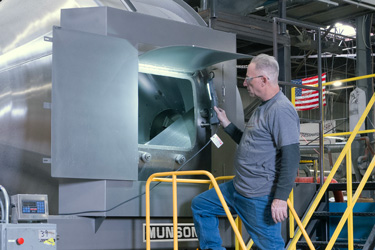
Access doors allow rapid cleaning and visual inspection of all material contact surfaces.


Click to enlarge

Operator programs mixing cycles at a frame-mounted control panel.


Click to enlarge

Internal flights direct blended material toward and through a plug gate valve with no stratification into a Gaylord on a scale.

Click to enlarge

Proprietary mixing flights impart a gentle four-way tumble–fold–cut–turn mixing action that achieves batch uniformity in one to three minutes with no heat generation.

Click to enlarge

A box dumper unloads the contents of each container into a portable stainless steel hopper.

Click to enlarge

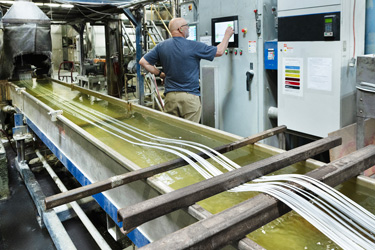
Extruded engineered thermoplastics are cooled and pelletized.

Click to enlarge

The hopper is forklifted above the Rotary Batch Mixer inlet where the contents are discharged via a knife gate into the mixer as it rotates.

Click to enlarge

Click to enlarge

Click to enlarge

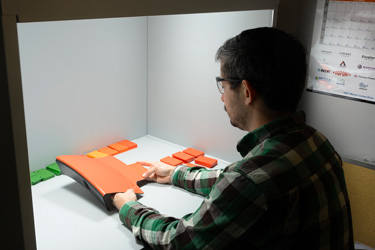
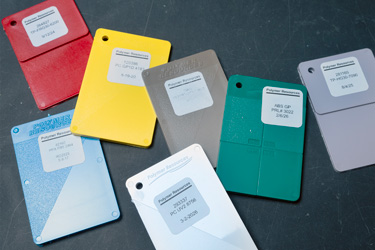
Color quality is validated with both a spectrophotometer and by visual inspection.

Click to enlarge

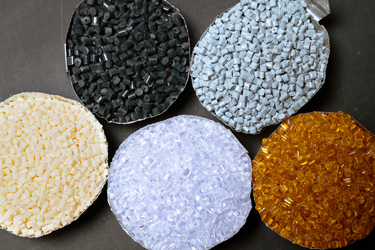
Polymer Resources' Farmington, CT headquarters produces specialized engineering resins in custom colors.

Click to enlarge

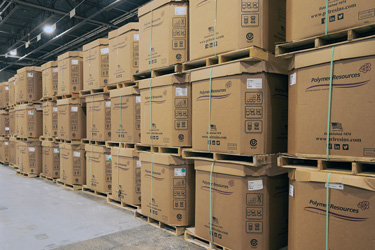
Polymer Resources' engineering resins ship to a global network of molders and extruders.