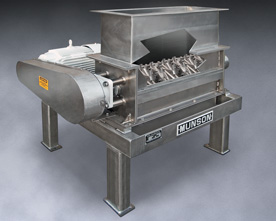
Munson's HammerHead™ Hammer Mills reduce an exceptionally wide range of friable, non-friable and fibrous materials into particle sizes from coarse pieces down to 200 mesh, determined by friability of the material.
The high-shear/low-resistance cutting action of the hammer tips rotating at speeds up to 270 MPH, together with the rotational inertia of the heavy-weight rotor assembly, reduces higher volumes of materials and yields greater output per horsepower/kilowatt than with many other types of mills.
Centrifugal force causes pivoting hammers to stand at 90° to the rotating shaft, striking material in mid-air and smashing it at high speed against hardened breaker plate ridges until particles are sufficiently reduced to pass through a bed screen.
Particle sizes are determined by the friability of the material and the size of bedscreen perforations which range from 1/32 to 3 inch (0.8 to 76 mm).
The shaft assembly, which consists of a primary shaft, multiple discs and six hammer mounting bars, are driven at 1,800 to 3,600 RPM by a high horsepower motor.
The proprietary hardened hammers can be reversed end-to-end and side-to-side, allowing all four cutting edges to be utilized before being replaced. A removable pin, recessed within a hardened steel guard, allows rapid removal of the secondary shafts, hammers and spacers for servicing.
In addition, all corners of the hammers are stepped as standard, offering three-times the cutting edges of square-cut hammer tips for greater efficiency.
For general grinding, standard equipment consists of alternating heavy and light hammers. However, the type, number and arrangement of hammers can be varied readily to optimize performance according to material characteristics.
The unit is configured with a large safety-interlocked door, providing rapid, unobstructed access to the mill case interior.
The upper cylindrical breaker plates and lower bed screens slide within precision-machined channels, and are held captive by the unit's door when closed, providing secure, dust-tight operation as well as rapid removal of internals.
As standard, cylindrical breaker plates encircle the upper half of the mill chamber, while bed screens encircle the lower half. However, when greater throughput of easily-reduced materials is desired, a 90° section of breaker plate located below the hinged top section of the mill case can be substituted with a 90° cylindrical section of bed screen, increasing total screen area to 270°.
Material is fed through the infeed hopper at the top of the mill, while on-size particles exit through a lower flanged outlet, and are typically removed by dilute-phase vacuum collection, or are gravity fed into a downstream process.
The heavy-gauge housing provides the stiffness required to maintain precise alignment, and withstand the extreme impact and high loads of the most demanding applications.
The rotor assembly, which is powered by a fully guarded, directly-coupled drive, rides on sealed flange-block bearings mounted on a heavy-gauge fabricated and machined housing, providing vibration-free operation.
Carbon steel or stainless steel construction in a range of finishes is offered to satisfy virtually any industrial requirement.
IMPORTANT NOTE: Since all hammer mills are limited in terms of particle size control and prevention of fines, MUNSON Centrifugal Impact Mills (Pin Mills) and MUNSON SCC™ Screen Classifying Cutters may alternately be considered.

Click to enlarge
The shaft assembly consists of a primary shaft of alloy steel, multiple shaft discs and six quick-disconnect hammer mounting bars with "stepped-tip" hammers shown standing at 90° to the rotating shaft from centrifugal force. (Shown in open position for demonstration purpose only. Never bypass safety devices to operate in open position.)

Click to enlarge
Mill case and hinged access door — both constructed of welded heavy-gauge carbon steel and machined flanges — are secured by an equally robust latch assembly.





_sm.jpg)


